The Kintsugi Mindset: Finding Beauty in Your Brokenness
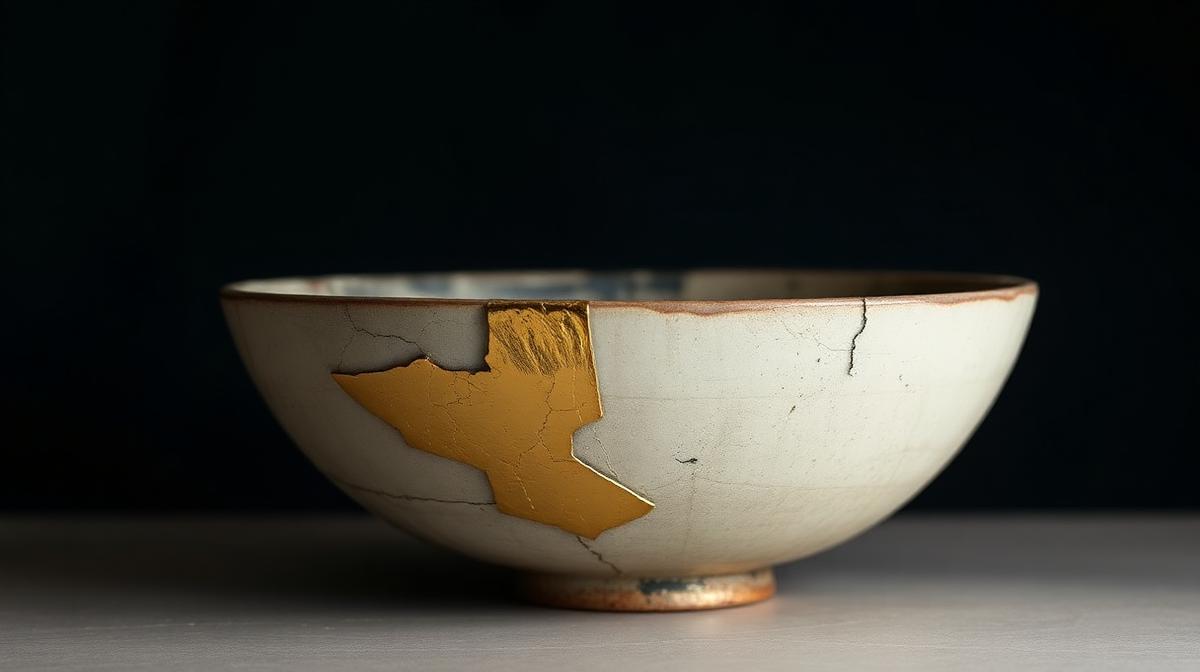
In Japan, there's an ancient art called kintsugi — the practice of repairing broken pottery with lacquer mixed with powdered gold. Rather than hiding the damage, kintsugi highlights it. The broken places become the most beautiful parts of the piece. The vessel isn't restored to its original form — it's transformed into something more valuable.
This isn't just an art technique. It's a philosophy of life that can fundamentally change how you relate to your own damage, failures, and wounds.
"The world breaks everyone, and afterward, many are strong at the broken places." — Ernest Hemingway
The Western approach to brokenness:
Western culture generally treats damage as something to hide, fix, or overcome. We conceal our scars — physical and emotional. We speak of "getting over" grief, "moving past" trauma, "putting it behind us." The implicit message: damage diminishes you. The goal is to return to the pre-broken state.
The kintsugi philosophy offers a radical alternative: damage doesn't diminish you — it distinguishes you. Your breaks aren't flaws to hide; they're the golden seams that make you unique.
The psychology behind kintsugi:
Post-traumatic growth (PTG), researched extensively by psychologists Richard Tedeschi and Lawrence Calhoun, demonstrates that many people don't just recover from adversity — they grow beyond their pre-trauma baseline. They develop greater appreciation for life, deeper relationships, increased personal strength, recognition of new possibilities, and spiritual development.
This doesn't mean trauma is good or that suffering should be sought. It means that when suffering happens — as it inevitably does — it carries the potential for transformation, not just recovery.
The Motivational app draws from this understanding. Many of the most powerful quotes in the collection come from people who endured profound suffering: Viktor Frankl survived the Holocaust, Helen Keller overcame deafblindness, Nelson Mandela spent 27 years in prison. Their wisdom isn't despite their brokenness — it's because of it.
Applying kintsugi to your life:
1. Stop hiding your scars. You don't need to broadcast your pain to everyone, but selectively sharing your story — your real story, including the breaks — creates connection and gives others permission to be authentic too.
2. Reframe your narrative. Instead of "I'm damaged because of what happened," try "I'm shaped by what happened." The event is the same; the framing transforms its meaning.
3. Find the gold in the breaks. What did your worst experiences teach you? What strengths did they develop? What compassion did they create? What wisdom did they offer? This isn't minimizing the pain — it's refusing to let pain be the only outcome.
4. Practice wabi-sabi. The broader Japanese aesthetic of wabi-sabi celebrates imperfection, impermanence, and incompleteness. Your wrinkles, your failures, your inconsistencies — these aren't flaws. They're evidence of a life fully lived.
5. Help others see their gold. When someone shares their brokenness with you, don't rush to fix it. Instead, help them see the beauty in their repair. "Look how strong you've become because of this" is a more powerful response than "I'm sure you'll get over it."
The art of golden repair:
The kintsugi master doesn't rush the repair. Each piece is carefully fitted, each crack carefully filled with gold. The process takes patience, skill, and an appreciation for imperfection. Your own repair works the same way.
Therapy, reflection, journaling, daily practices like reading the Motivational app — these are all forms of golden repair. They don't erase what happened. They transform it into something meaningful.
You are not broken despite what you've endured. You are a kintsugi masterpiece — cracked, repaired with gold, and more beautiful for having been broken.
Ready to start your journey?
Try the Motivational app for daily quotes, habits, widgets, and Moti AI coaching.
 Download free
Keep reading



Related quote collections
Browse all 60+ quote topics or read more on the blog.